Published in the first edition of Wellcome Open Research is an article featuring some of the post-doctoral work of Dr. Lloyd-Evans. This article entitled “Pathogenic mycobacteria achieve cellular persistence by inhibiting the Niemann-Pick Type C disease cellular pathway” focuses on the potential role of the NPC1 protein as a target for Mycobacterium tuberculosis, the infectious agent that causes tuberculosis. As one of the leading killers in the under developed world, tuberculosis remains a major human health issue. That the lysosome was involved in tuberculosis was never in question but that a lysosomal disease protein is involved in the process of pathogenicity is an extremely novel finding and highlights new potential therapeutic avenues. Published in this novel journal, with open peer review, it will be interesting to see what people make of the research. We here at the Lloyd-Evans lab would like to pass on our congratulations to all the co-authors involved in the study.
Luke off to St. Andrews to do some collaborative ion channel work
For the next two weeks Luke will be visiting the lab of Dr. Sam Pitt at St. Andrews University to learn single channel recordings as part of our NCL research project funded by the NCL Stiftung.
St. Andrews is the third oldest of the English speaking Universities in the world and is also known for it’s golf course. Luke will be there to complete work for a paper and to pick up these techniques so we can eventually establish single channel recordings at Cardiff.
Many thanks to Sam for assisting us with this work and we hope this will be the beginning of further collaboration on this and other projects down the line.
Lloyd-Evans lab at BDFA annual meeting in Stratford upon Avon
We’ve just got back from the 2016 Batten Disease Family Association annual conference which was very successful, interesting, emotive and humbling, as always!
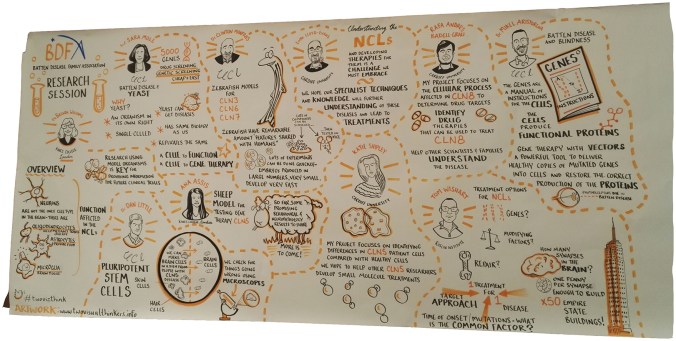
Katie gave a fantastic presentation on her Cardiff Uni/Battle Batten & BDFA funded CLN5 project and Rafa did a great job introducing his Life Science Research Network Wales/BDFA funded CLN8 PhD project to an audience including families, professionals and care givers. Luke joined us on Sunday to present a poster on his Action Medical Research funded work on the function of CLN3, which attracted attention from families present at the meeting. We’re privileged to be part of this community and energised by this meeting to do what we can to further our understanding of these devastating diseases.

Behind us all is this rather impressive artwork using some of our quotes during the meeting and created by www.twovisualthinkers.info:
Helen Waller-Evans starts BATcure project!
We are delighted that Dr. Helen Waller-Evans will remain with us as a post-doc for at least the next two years having taken the position of post-doctoral scientist in our lab on the European Union funded BATcure consortium. Helen is an excellent scientist with all the necessary skills to complete the work outlined in our BATcure work package. Helen will predominantly work on CLN6 disease whilst also assisting and providing support for our various CLN3 projects.
New PhD opportunity in Lloyd-Evans lab
Investigating the impact of metallic nanoparticles on biological systems and lysosomal function
The Lloyd-Evans lab, as part of the MRC funded GW4 consortium (Bath, Bristol, Cardiff and Exeter), is offering a competitively funded PhD project to uncover the impact of metallic nanoparticles on lysosomal function in vitro and in vivo. Metallic nanoparticles ultimately accumulate in lysosomes and have recently been found to be capable of crossing the blood brain barrier and entering the brain. The aim of this project is to determine what impact long term exposure to these nanoparticles has on lysosomal function, especially in the brain, and whether they contribute to neurodegenerative phenotypes such as Alzheimer’s. The project involves the use of cutting edge microscopy (light sheet microscopy, dual radiometric imaging), cutting edge subcellular fractionation techniques (magnetic separation) and cutting edge chemistry techniques (in collaboration with colleagues at Cardiff and Bath). Applications are welcome until November 30th, 2016 and can be made via the following websites:
https://cardiff.onlinesurveys.ac.uk/gw4biomeddtp-studentapplication
 Lloyd-Evans Lab
You must be logged in to post a comment.